What is a Factory Roof? Classification of Factory Roofs
January 22, 2026 06:56 AM
When mentioning a factory, we often immediately visualize a large production space with modern machinery and a bustling team of workers. In that picture, there is a component that plays the role of protecting all operations underneath that we sometimes inadvertently overlook: the factory roof. 1. What is a Factory Roof? The factory roof is […]
When mentioning a factory, we often immediately visualize a large production space with modern machinery and a bustling team of workers. In that picture, there is a component that plays the role of protecting all operations underneath that we sometimes inadvertently overlook: the factory roof.
1. What is a Factory Roof?
The factory roof is the covering structural system on top of a factory building. This is a complex technical system that performs many important functions in protecting and supporting production operations.
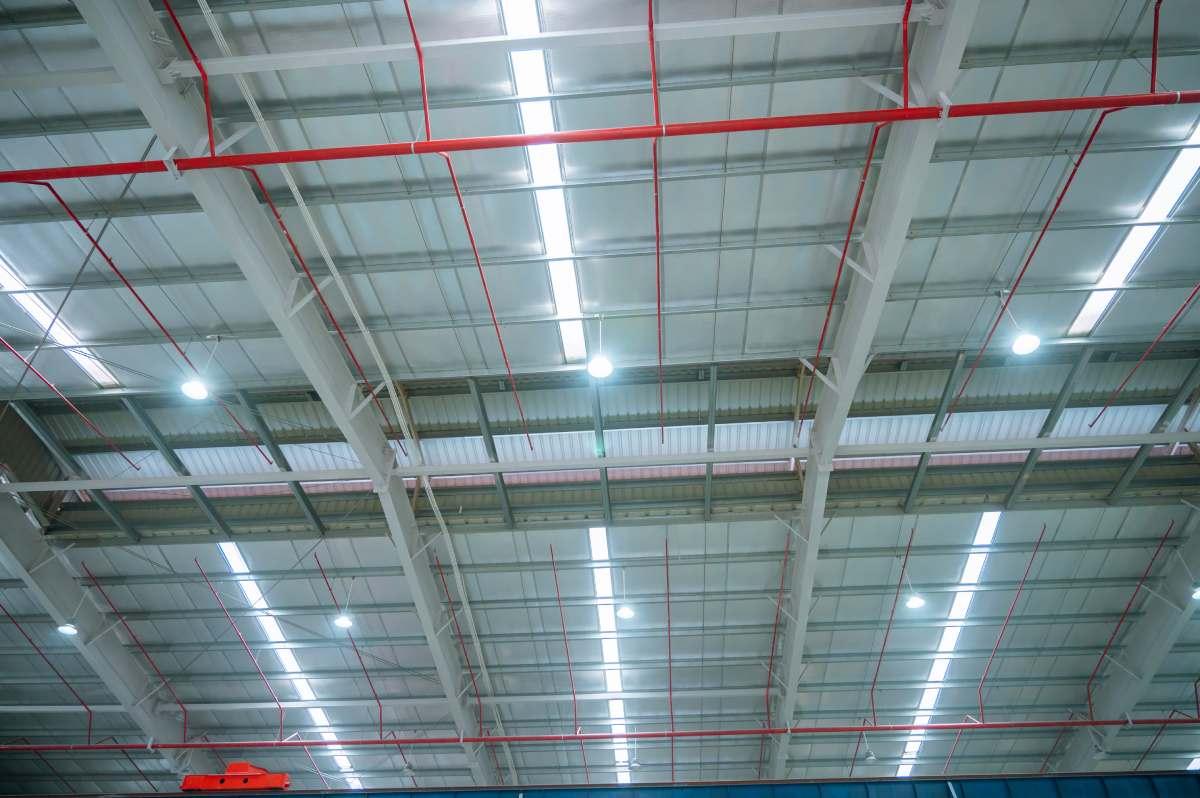
The factory roof is the shielding part for the entire industrial factory.
2. Important Role of Factory Roofs in Industrial Projects
In the structure of an industrial project, the factory roof plays a particularly important role, contributing to protecting the interior space and maintaining a stable working environment.
- Shielding and Protection: This is the most basic and essential function, helping to protect the entire interior space from environmental impacts such as rain, sun, wind, storms, etc.
- Load Bearing and Distribution: The factory roof must be designed to withstand its own weight, as well as loads from technical equipment (ventilation fans, solar panels, etc.) and wind/rain loads.
- Supporting Ventilation and Lighting: Modern roofs often integrate skylights, roof turbines, and translucent sheets to maximize natural light and air flow, thereby saving energy and creating an airy working environment.
- Heat and Sound Insulation: Insulation layers (PU, EPS, Glass wool, etc.) and soundproofing help keep the temperature stable and reduce noise from rain or the outside environment.
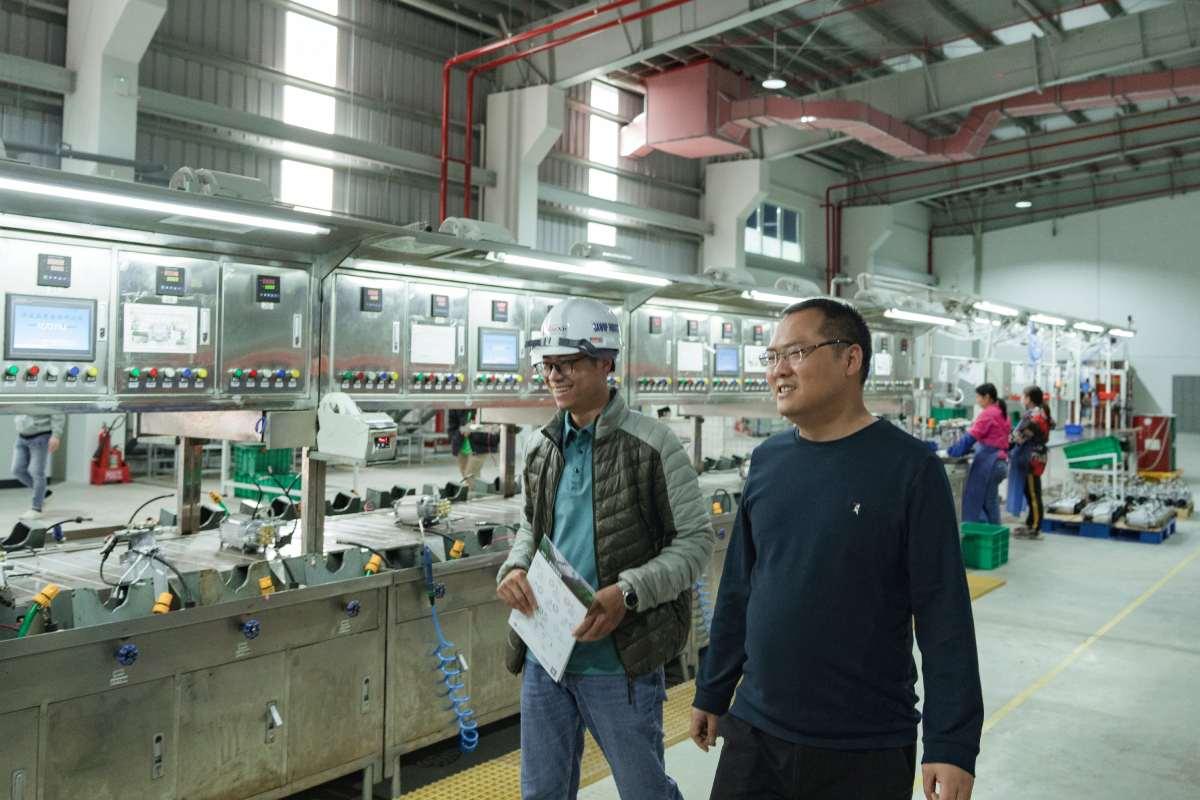
The factory roof protects the interior space.
3. Factors Influencing Factory Roof Design
Selecting and designing a factory roof depends on many different factors, not simply an arbitrary decision. An optimal design needs to balance function, cost, durability, and specific technical requirements.
3.1. Climate and Environment at the Construction Site
The roof design must adapt to natural conditions such as heavy rain, strong winds, or heat. The roof needs a reasonable slope for good drainage, a frame and bracing system reinforced against storms, and thermal insulation materials like cold-rolled steel or PU panels to reduce heat absorption.
3.2. Specific Function of the Factory
Factory function determines the scale of the roof structure and auxiliary requirements. Large workshops need sturdy trusses to span large distances; heat or dust-generating industries need good ventilation through roof monitors or turbines; and if there is noise, the roof needs suitable soundproofing materials like Rockwool panels.
3.3. Economic Factors and Investment Budget
Budget directly affects the chosen materials and structure. Low-cost solutions like single-layer metal sheets fit limited budgets, but in the long run, a high-quality roof will help save electricity, reduce maintenance, and improve overall operational efficiency.
3.4. Construction Standards and Fire Safety (PCCC)
Factory roof design must comply with Vietnamese Standards (TCVN) and safety requirements, especially Fire Prevention and Fighting (PCCC). For industries with fire and explosion risks, it is necessary to choose non-combustible or fire-retardant roof materials such as mineral wool core panels to ensure maximum safety.
4. Common Types of Factory Roofs Today
Currently, common factory roof types can be classified based on structural shape as follows:
4.1. Pitched Roof (Gable Roof)
This is the most popular type in factory projects in Vietnam today. The structure consists of two slopes tilting to two sides, intersecting at the ridge. The slope usually ranges from 10–15% to ensure effective drainage.
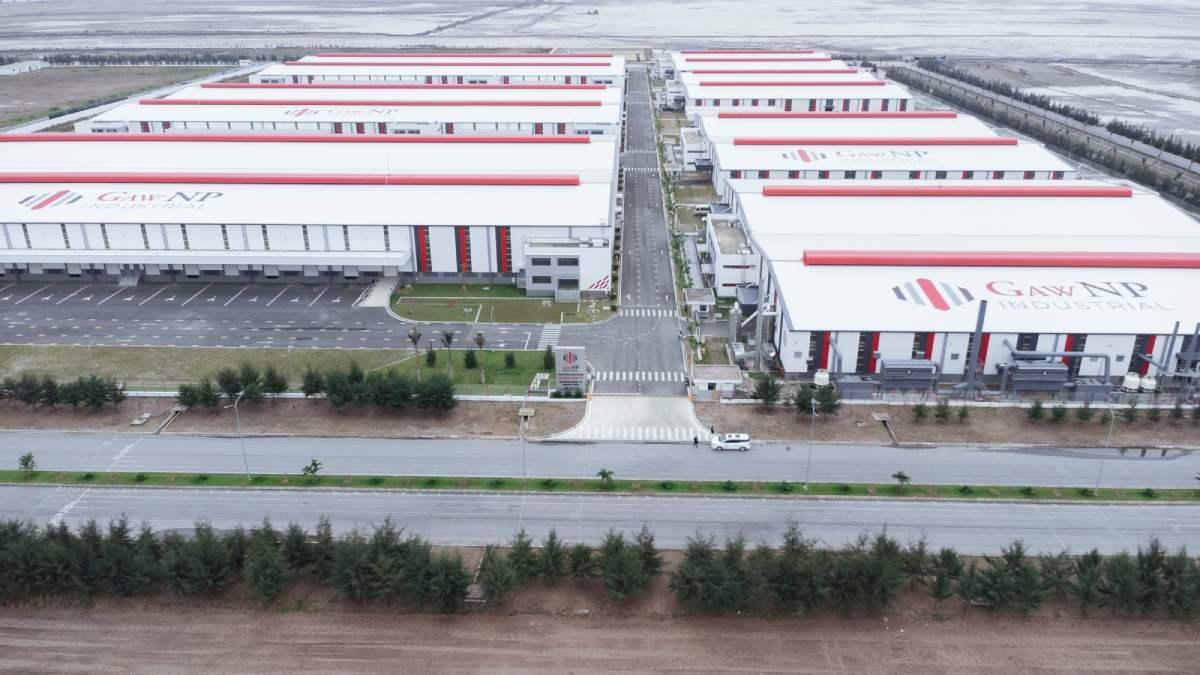
Traditional pitched roof is the most popular type in factory projects in Vietnam today.
- Advantages: Simple construction, reasonable cost, fast drainage, suitable for most weather conditions in Vietnam.
- Disadvantages: Limited natural ventilation and lighting; requires supplementary solutions like roof turbines or translucent sheets.
- Application: Warehouses, small and medium-sized production workshops not requiring high natural light.
4.2. Saw-tooth Roof
The saw-tooth roof is the optimal choice for factories needing abundant natural light and effective ventilation. The roof structure consists of a series of single-slope roof blocks arranged in parallel, where the vertical face is fitted with glass or translucent sheets facing North to avoid direct sunlight.
- Advantages: Provides uniform natural light, saves electricity, supports effective ventilation.
- Disadvantages: Complex structure, high investment cost, prone to leakage issues if not constructed carefully.
- Application: Textile factories, printing houses, workshops requiring good light and a precise working environment.
4.3. Arched Roof (Curved Roof)
The arched roof creates a modern, impressive architectural space and allows for large spans without intermediate columns. The steel frame system is curved, combined with Seamlock or Cliplock sheets capable of roofing on curved surfaces without penetrating screws.
- Advantages: Optimizes usable space, high aesthetics, good natural ventilation thanks to the dome height.
- Disadvantages: Complex fabrication and construction, higher cost than traditional roof types.
- Application: Stadiums, exhibition centers, logistics warehouses, super-heavy industrial factories.
4.4. Reinforced Concrete Roof (RC Roof)
Completely different from metal roofing, RC roofs offer high durability and fire resistance, often used in projects with special technical requirements or integrated rooftop usage.
- Advantages: Very solid, good load-bearing, superior sound and fire insulation, roof surface can be utilized for technical purposes or amenities.
- Disadvantages: Heavy weight, requires high load-bearing foundation and structure, long construction time, complex waterproofing treatment.
- Application: High-tech factories, multi-story workshops combined with offices, projects with strict fire safety requirements.
5. How to Choose Suitable Factory Roofs
To select the optimal roof solution for the project, the investor needs to carefully consider three core factors, corresponding to three strategic questions: What is it built for? Where is it built? And what is the budget?
5.1. Based on the Usage Purpose
Function is the prerequisite factor influencing roof shape and structure.
- Factories that rely heavily on natural light, such as those in textiles or electronic assembly, prefer saw-tooth roofs as their priority choice.
- For mechanical or metallurgical workshops generating heat and dust, pitched roofs combined with roof monitors help ventilate effectively.
- For warehouses and logistics centers needing large storage space, arched roofs are the optimal solution to span wide areas without center columns.
- For projects with high fire safety requirements or needing to install heavy equipment on the roof like chillers or solar panels, reinforced concrete roofs are a mandatory choice.
5.2. Analyzing Climate and Terrain Conditions
The roof is the first part to withstand the weather, so the construction environment needs careful assessment:
- High rainfall areas: Should use pitched roofs to ensure fast drainage, reducing leakage risks.
- Coastal, high wind/storm areas: Require roofs with sturdy reinforced structures and connections to prevent roof uplift.
- Year-round hot areas: Should invest in heat-insulating materials like 3-layer panel sheets to reduce the load on the cooling system and save electricity.
5.3. Investment Cost Estimation and Long-term Efficiency
Cost is a practical factor directly affecting design and material selection:
- Single-layer metal roofs have the lowest cost, suitable for limited budget projects.
- Reinforced concrete roofs are the most expensive option but ensure durability and high load-bearing capacity.
- Initial investment in insulated roofs, skylights, or high-quality materials will bring long-term economic efficiency: saving monthly electricity costs and reducing future maintenance/repair costs.
6. Technical Standards for Factory Roof Design
Besides relying on experience, factory roof design and construction must strictly comply with national technical standards to ensure safety, durability, and legal compliance.
6.1. Appropriate Roof Slope
- For metal roofs, the minimum slope should be in the range of 10–15%, commonly 15–20% to ensure good drainage and avoid stagnation.
- For reinforced concrete roofs, a reasonable slope is 5–8%, to lead water to the collection points (drains) effectively.
- Additionally, TCVN 4604:2012 also specifies different slopes depending on the material: corrugated sheets 15–20%, concrete roofs 5–8%, fibro-cement sheets 30–40%, etc.
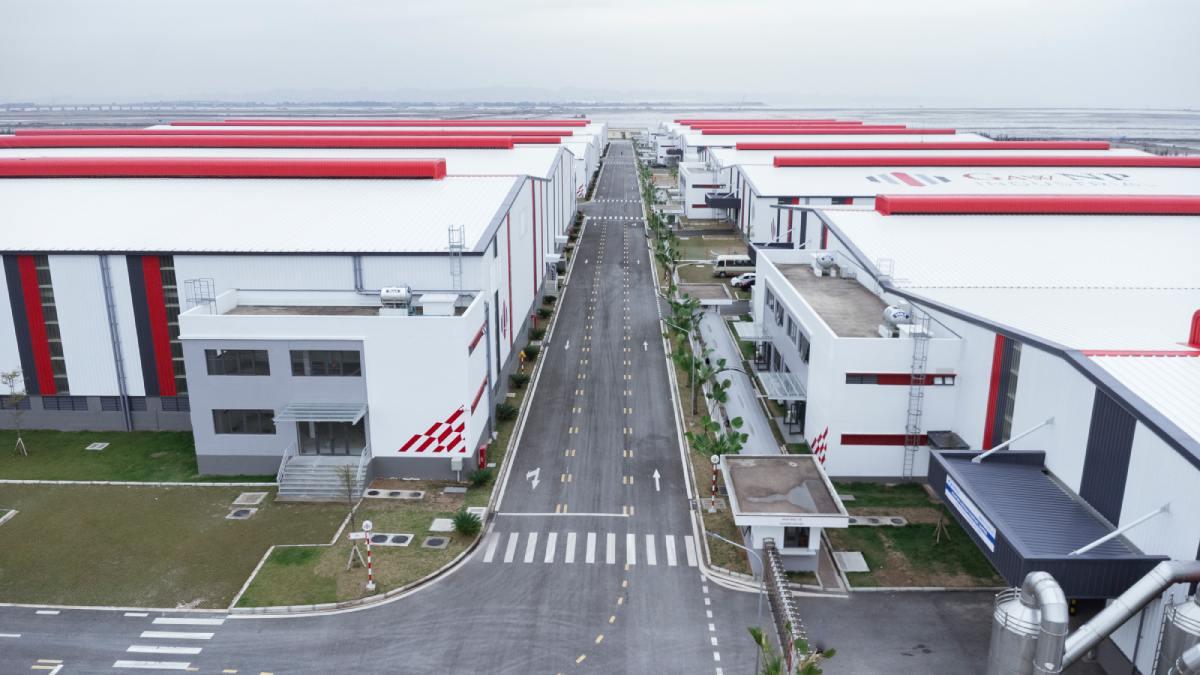
Design appropriate roof slope to avoid water stagnation.
6.2. Load Bearing Capacity
Roof design must meet the load types specified in TCVN 2737:1995, including:
- Dead load: Weight of structural components and roof materials.
- Live load: Such as force from people or mobile equipment on the roof (maintenance, chillers…).
- Wind load: According to QCVN 02:2022/BXD, calculating both downward pressure and uplift force on the roof.
- Other loads: Such as pressure from stagnant rainwater or snow (if any).
6.3. Fire Prevention and Fighting (PCCC) Compliance
Roof design must comply with QCVN 06:2022/BXD (amended by Circular 09/2023):
- Roof materials: Prioritize non-combustible or difficult-to-burn materials like mineral wool core panels (Rockwool).
- Smoke escape solution: Design roof monitors or skylights that can open automatically so smoke can escape quickly, supporting safe evacuation.
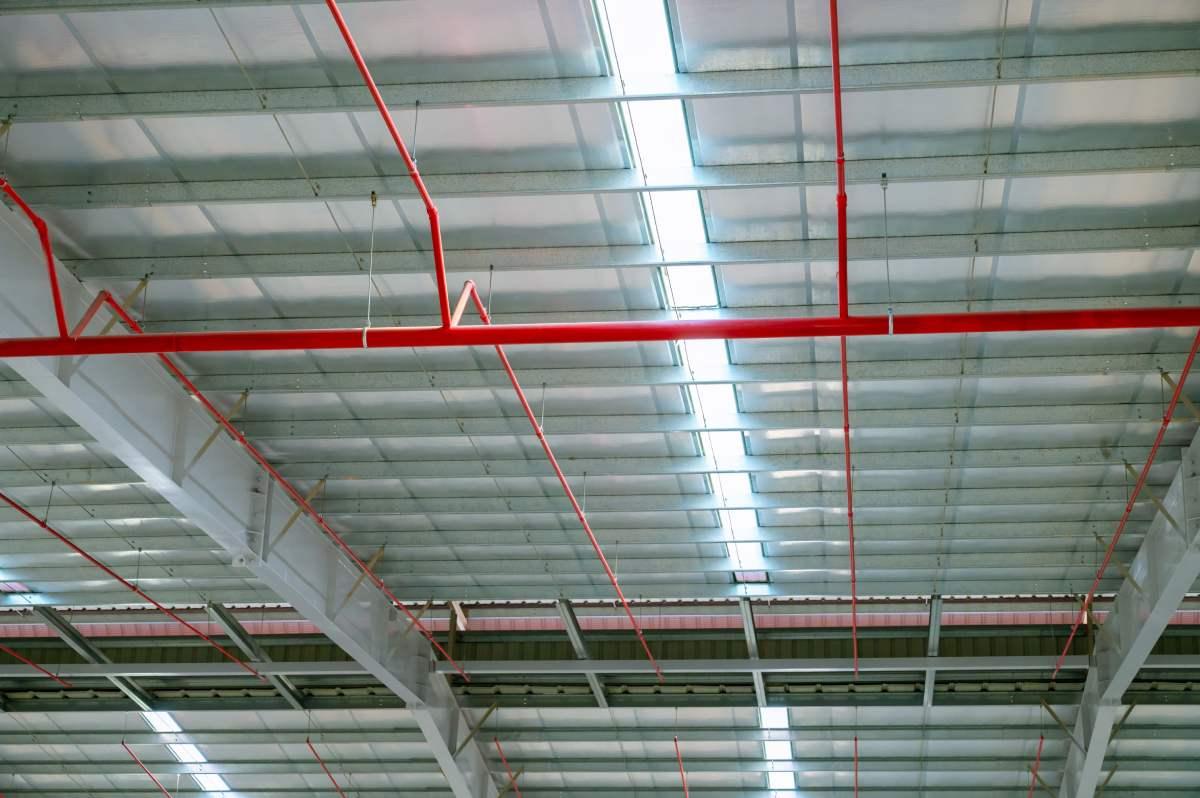
Factory roof needs to be made of materials complying with PCCC regulations.
7. Some Notes During Factory Roof Construction
7.1. Correct Technical Construction
Construction needs to be carried out precisely and synchronously step by step:
- Input material check: Ensure all materials such as sheets, purlins, panels, screws… are of the correct type, not warped, dented, or scratched on the protective coating.
- Accurate steel frame erection: The truss and purlin system needs to be in the correct position, correct elevation, and ensure flatness. All bolts and connections must be tightened to standards.
- Correct roofing technique: Install from bottom to top, opposite to the main wind direction. Longitudinal and transverse laps must overlap correctly to prevent water splashing and capillary action.
- Proper screw fastening: Screws must be driven perpendicular to the wave crest, with just enough tightening force to compress the gasket without causing deformation.
- Waterproofing weak points: Locations such as the ridge, roof junctions, gutters, and openings must be sealed with specialized silicone sealant.
7.2. Ensuring Labor Safety
Working on high roofs always carries many potential risks, so safety measures must be strictly implemented:
- Full protective equipment (PPE): Workers need helmets, shoes, gloves, and safety harnesses hooked to secure positions.
- Safety nets: The entire area under the roof needs nets to prevent people or materials from falling.
- No working in bad weather: Heavy rain, thunderstorms, or strong winds are conditions requiring immediate work stoppage.
- Use standard lifting equipment: Cranes, forklifts, and support equipment must be inspected and operated only by qualified personnel.
7.3. Strengthening Supervision and Acceptance
Supervision and acceptance are the final steps to ensure actual quality matches the design drawings:
- Active and continuous supervision: The monitoring unit needs to regularly compare actual construction with the design, detecting deviations to request timely correction.
- Thorough acceptance: Before handover, check the overall roof for flatness, tightness, cleanliness, and screw/joint positions. A water spray test can be conducted to check for leaks.
8. Frequently Asked Questions (FAQs)
8.1. How much does a factory roof cost per square meter?
For factory roof construction costs, there is no fixed price as it depends on many factors:
- Material type: Single-layer sheets are cheaper than 3-layer panels.
- Roof structure: Pitched roofs are usually cheaper than saw-tooth or arched roofs.
- Thickness and brand: Thick materials from reputable brands will be more expensive.
- Construction unit: The price also depends on workmanship and construction experience. To get an accurate quote, it is recommended to provide design drawings and specific requirements to the contractor.
8.2. Should I choose a metal roof or concrete roof for a factory?
- Metal roof: Fast construction, lightweight, low cost, easy ventilation/lighting. Suitable for most current factories.
- Concrete roof: Good fire resistance, high load-bearing (suitable when placing chillers, water tanks…), but higher cost and construction time.
8.3. How to effectively heat-insulate the factory roof?
There are 3 most effective heat insulation solutions:
- Using insulated sheets (EPS, PU, Rockwool panels…).
- Arranging ventilation systems such as roof monitors, wind turbines.
- Painting heat-reflective thermal insulation paint on the roof surface.
8.4. What is the average lifespan of a factory roof?
Different materials will affect the lifespan of the factory roof differently:
- Galvanized/Regular metal sheet: 10–20 years.
- Premium Panel sheet: 30–50 years if well maintained.
- Reinforced concrete roof: Over 50 years but requires periodic waterproofing treatment after 10–15 years.
Conclusion
In summary, there is no single factory roof type that is best for every case. The most optimal solution is the one most suitable for your specific production characteristics, climate conditions, and budget. From economical traditional pitched roofs, efficient light-gathering saw-tooth roofs, to large-span arched roofs or sturdy concrete roofs, each choice has its own pros and cons.
Warehouse for lease in Vietnam | Warehouse for rent in Vietnam | Factory for lease in Vietnam | Factory for rent in Vietnam